
Yesterday, the Centers for Disease Control and Prevention (CDC) hosted a webinar highlighting how rural health leaders in Utah have turned CDC funding into meaningful and sustainable impact.
The discussion was moderated by Diane Hall, Director of the CDC’s Office of Rural Health, and featured three leaders whose organizations REDi Health has had the privilege of supporting:
- Liz Craker, Health Systems Support Coordinator at the Utah Department of Health and Human Services
- Jeremy Lyman, President of Blue Mountain Hospital, which was recently acquired by Utah Navajo Health System
- Preston Marx, Vice President of Strategy and Innovation at Uintah Basin Healthcare
Each panelist brought a distinct perspective, but a common theme emerged: collaboration has been essential to making the most of this funding and ensuring the work continues beyond the initial funding period. We’re grateful to have supported these organizations as they transformed an important opportunity into lasting value for Utah’s rural communities.
Several members of the REDi Health team attended the webinar. In this article, we’re sharing a few of their individual perspectives on what they heard—the ideas that stood out, the lessons they’re carrying forward, and the moments that reinforced why this work matters.
See our team members’ takeaways below:
Recording link forthcoming.
Takeaway #1: Data Can Reveal Blind Spots
My takeaway from the CDC webinar is that data is key to identifying blind spots that rural hospitals can use to improve financial sustainability.
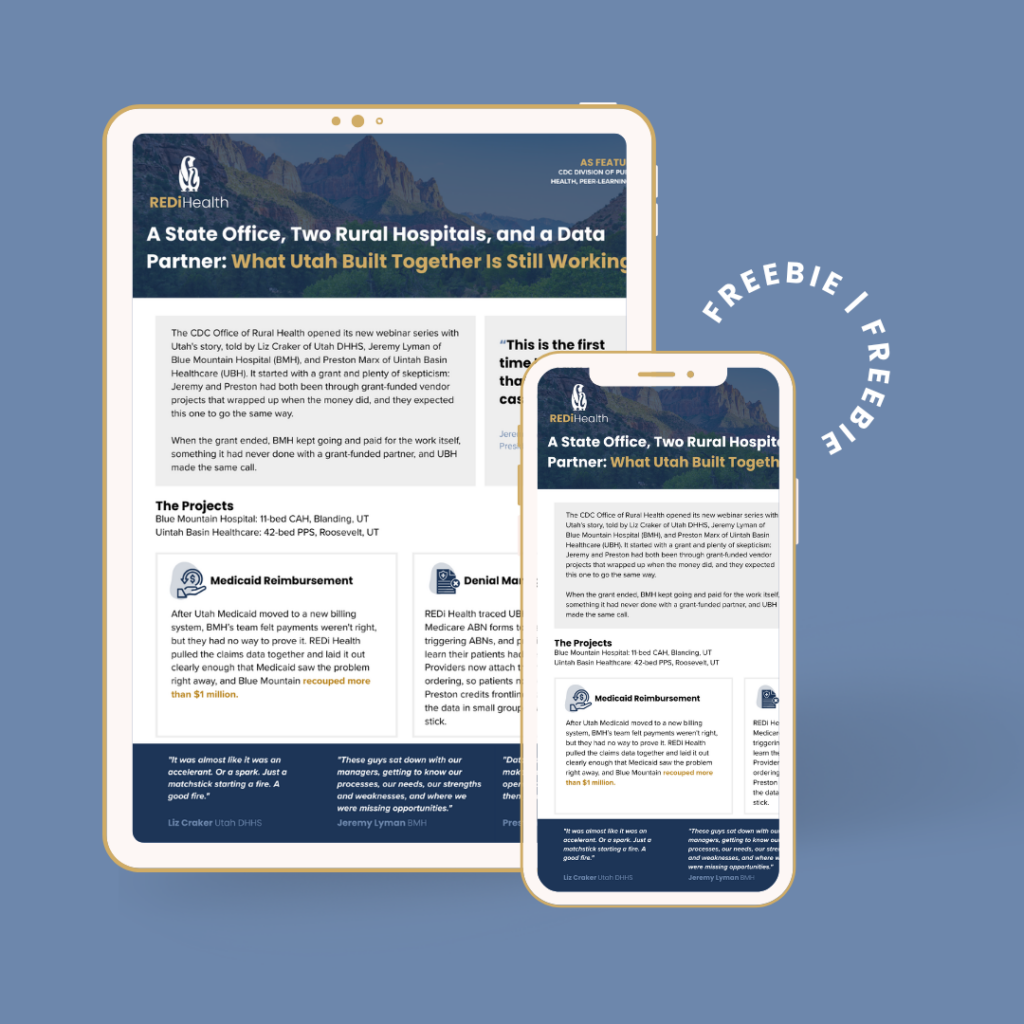
One example that stood out was Blue Mountain Hospital. Like many rural hospitals, the team had access to a lot of data, but they didn’t necessarily have the resources to analyze it in a way that could uncover potential deficiencies. They suspected something wasn’t right with their Medicaid reimbursement, but they couldn’t pinpoint or prove what was happening. By helping them pull together and analyze the data, our team identified the issue. Blue Mountain Hospital then brought it to Medicaid, ultimately helping the 11-bed critical access hospital recoup more than $1 million.
For a small rural hospital, $1 million can make a tremendous difference, not only for the hospital’s financial sustainability, but for its ability to continue serving the community that depends on it. Even CDC moderator Diane Hall was struck by the number, calling it “very significant for a hospital.”
That’s exactly why we do what we do at REDi Health. Meaningful opportunities can be hidden in a hospital’s data, but you have to find them and turn that information into action. When that happens, the impact can reach far beyond the numbers on a dashboard.
And those blind spots aren’t always obvious. They can show up in reimbursement, denials, registration, charge capture, or even clinical workflows. Having the data is one thing. The real value begins when you can see what it’s telling you and where to focus your efforts.
Takeaway #2: Data Can Be a Tool for Change, Not a Weapon
Data can reveal where change is needed, but identifying an issue is only the first step. Equipping your team with the tools, resources, and support to understand what the data is showing and empowering them to act on it is what helps meaningful improvements take hold and last.
Preston Marx from Uintah Basin Healthcare shared a story about a team member who participated in one of the hospital’s workgroups and discovered through the data that registration issues were contributing to downstream denials.
“Through her tears, she said, ‘I wish I had known that what I was doing was causing problems downstream.’ I thought in that moment how tragic it would have been if we had used the data as a weapon against her rather than as a tool to help her change and improve.”
That story really stuck with me. At REDi Health, our role isn’t to hand someone a dashboard and point out what they’re doing wrong. It’s to give teams the tools and resources to understand what the data is telling them, see how their work connects to the bigger picture, and feel empowered to be part of the solution.
That approach is also key to fostering a positive work culture. When data is used to educate and empower rather than place blame, it can build trust, create buy-in, and give employees a greater sense of ownership in the changes being made.
Takeaway #3: Relationships Make the Difference
In rural healthcare, relationships make all the difference, both in the success of a project and in whether meaningful change actually happens within a team. Critical Access Hospitals, State Offices of Rural Health, and vendors need to be aligned around the same goals, and that starts with a real working relationship. It has to go beyond delivering a report or checklist and walking away. It requires listening, understanding each hospital’s unique needs, and meeting teams where they are.
Jeremy Lyman, President of Blue Mountain Hospital, shared that he was skeptical at first because of previous experiences with vendors. He said that in past projects, it typically went: “here’s the engagement, here’s what the funding’s gonna pay for, and then it’s over,” and the hospital may or may not have received much lasting value.
He described the experience with REDi Health as “a night and day difference.” Rather than arriving with a predetermined solution, he said, “These guys sat down with our managers and spent time asking questions, getting to know our processes, our needs, our strengths and weaknesses, and where we were missing opportunities.” That relationship helped turn initial skepticism into engagement and gave hospital leaders more ownership and buy-in during the work.
Liz Craker with the Utah Department of Health and Human Services shared a similar perspective. She emphasized that successful partnerships require active involvement, saying, “You don’t just spend money and make a contract. You’ve got to be involved.”
One example that stood out to me was how hands-on that involvement became. Liz described REDi Health sitting “elbow to elbow” with hospital staff and even using LEGOs to explain how different pieces of data connect. This helped frontline staff see their role in the larger process and understand how their work could affect patient outcomes.
To me, it was one of the clearest examples from the webinar of why relationships matter so much in rural healthcare. The value did not come from better data or technology alone, but from people taking the time to listen, work side by side, and build enough trust for real change to happen.
Takeaway #4: "I Don't Have Time to Not Do This"
Rural hospital teams are stretched thin. Finding additional time to dig into data, interpret it, and turn it into action can feel unrealistic. It leads to a challenge nearly every rural hospital knows well: “I don’t have time to do this.”
Liz Craker shared how that perspective began to change as hospitals saw the results of the work. She recalled one hospital team member initially saying, “I don’t have time to do this,” before eventually changing that to, “I don’t have time to not do this.”
That shift matters. The time invested in understanding the data can uncover opportunities that directly support a hospital’s financial and operational sustainability. The work also does not have to begin with a massive project.
Liz encouraged rural hospitals to start small: “You don’t have to conquer the whole world at once.” If denials are the issue, for example, start with one portion of them and begin measuring the return.
For rural hospitals with limited time and resources, the goal is not to take on everything at once. It is to choose a focused, high-value opportunity, learn from the data, and use the results to determine what comes next. A manageable first project can begin demonstrating whether the time invested is creating meaningful value.
Takeaway #5: Sustainability is the Proof Point
There is no shortage of discussion about transforming rural healthcare. But transformation is not proven by launching a new initiative; it is proven when the results last.
CDC funding gave Uintah Basin Healthcare and Blue Mountain Hospital an opportunity to explore how data could inform decision-making across their organizations. During the funding period, both hospitals applied that data to clinical and financial projects, building new capabilities and seeing firsthand what more informed decision-making could accomplish.
Near the end of the webinar, Diane Hall asked where the work stands today. Her question reached the heart of sustainability: What happened after the original funding ended?
The hospitals had reached an inflection point. They could conclude the projects and end the relationship with REDi Health, as they had with many previous vendor engagements, or they could continue investing in the work. Jeremy Lyman, President of Blue Mountain Hospital, explained their decision: “Even though the funding ended, we continued the engagement with that partner and started new projects. We’ve proven the ROI is there, not just financially, but also in operational efficiency, quality, and patient safety. There is no question for us: we’re continuing to work with the partner and continuing this work.”
Jeremy also shared that the projects “are paying for themselves.” The work demonstrated enough value for Blue Mountain Hospital to continue expanding its analytics capabilities and applying what it learned to new areas.
Uintah Basin Healthcare made a similar decision. Preston Marx described the original funding as a proof point that demonstrated the hospital could use trusted data to make meaningful changes. The organization now funds the work itself because it sees data as an investment and an asset rather than a temporary initiative. As Preston explained, that continued investment gives the work greater sustainability and allows the hospital to keep identifying new opportunities for improvement.
The work is also continuing at the state level. Liz Craker shared that the Utah Office of Primary Care and Rural Health continues working with REDi Health through the Medicare Rural Hospital Flexibility Program. That partnership is supporting additional financial, operational, and quality-improvement efforts, including chargemaster projects conducted through the Utah Hospital Association.
Together, these examples show that the value extended beyond one hospital or one set of projects. Blue Mountain Hospital, Uintah Basin Healthcare, and the state have each found ways to continue building on the original investment.
That may be the clearest measure of sustainability. The funding did more than support a temporary set of projects. It gave hospitals an opportunity to build their capabilities, demonstrate value, and create enough momentum to keep going. Along the way, hospital teams became more engaged, better equipped to understand and act on their data, and empowered to explore new opportunities for improvement. The work continued because it became valuable enough to sustain, and because those teams could see what more was possible for their organizations and communities.
Closing Reflection: Collaboration Turns Investment Into Lasting Impact
From Jeff Grandia, Co-Founder & CEO of REDi Health
It was meaningful to see REDi Health’s work highlighted as part of the progress happening across rural Utah, including our partnerships with the Utah Office of Primary Care and Rural Health, Uintah Basin Healthcare, and Blue Mountain Hospital.
I want to thank Diane Hall and the CDC for their leadership and continued commitment to rural communities. Federal investment gives rural hospitals and state partners the resources and capacity to address challenges that are often difficult to take on alone.
But funding is only the beginning. Lasting impact happens when state leaders, rural hospitals, local teams, and trusted partners work together to turn that investment into meaningful action. The goal is not simply to complete a funded project. It is to build knowledge, capabilities, and solutions that rural communities can continue using long after the original funding ends.
We value the trust our clients place in us and are proud to contribute to this work. Most of all, it is encouraging to see these rural communities recognized as an example of what is possible when the right people, resources, and partnerships come together around a shared commitment to better rural healthcare.