
Indiana has made regional collaboration a central part of its Rural Health Transformation Program (RHTP).
The state received $206,927,896.80 for the first year of RHTP. Indiana plans to use 40% of that funding for 11 coordinated statewide initiatives and direct the remaining 60% through the Growing Rural Opportunities for Well-being, or GROW, Regional Grants Program.
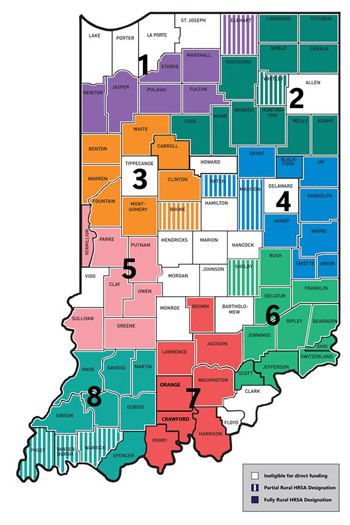
Through GROW, funding is distributed across eight rural regions. Rather than having every hospital or organization apply separately, regional coalitions identify local needs, develop shared strategies and coordinate projects across their communities.
What is the GROW Regional Grants Program?
Indiana describes GROW as a state-level version of the federal Rural Health Transformation Program.
Each of Indiana’s eight regions submitted one unified application representing its rural communities. Those applications outlined the region’s proposed initiatives, participating organizations, implementation responsibilities and budget needs.
To develop their plans, coalitions were expected to use community needs assessments and Indiana Department of Health data to identify gaps in care, duplicated services or infrastructure, opportunities to share costs, workforce shortages and other barriers to access. Regions also had to consider whether their projects could continue after RHTP funding ends.
Although each region submitted one application, the Indiana Department of Health awards funding directly to the primary organizations responsible for implementing approved projects through the GROW Regional Grants Program.
The model is designed to create coordinated regional strategies rather than a collection of disconnected projects. Depending on the region, coalitions include critical access hospitals, clinics, EMS agencies, behavioral health providers, local health departments, community organizations and schools.
Indiana is investing approximately $120 million per year through GROW
Indiana plans to invest about $600 million through the regional grant model over five years, depending on future CMS awards and annual funding adjustments.
The GROW Regional Grants launched September 1, 2026, with approximately $120 million awarded annually across Indiana’s eight rural regions.
Indiana’s funding formula combines regional need with the quality of each coalition’s application.
Eighty percent, or approximately $96 million, is base funding. Regional allocations are based on factors including population, access to care, Medicaid enrollment, infant mortality, diabetes, obesity and life expectancy.
The remaining 20%, or approximately $24 million, is tied to competitive scoring based on factors including each region’s strategy, partnerships, work plan, measurable outcomes, projected impact and sustainability plan. The methodology is outlined in Indiana’s GROW Request for Funding.
Indiana has now published its first regional awards, with nearly 200 organizations selected as subrecipients across the eight regions.
What GROW Regional Grants are funding
Regional initiatives must align with at least one of five funding categories: technology innovation, sustainable access, innovative care, workforce development and Make Rural Indiana Healthy Again.
Coalitions were also expected to address prenatal and postnatal care, chronic disease prevention and management, and barriers such as transportation, food access and health literacy. A region could leave out one of those areas only if it demonstrated that the need was already being addressed effectively, according to the GROW Request for Funding.
Indiana’s first round of GROW awards provides a clearer picture of how regions are putting those priorities into practice.
Across the eight regions, funded initiatives include maternal health, chronic disease management, transportation, behavioral health, EMS and emergency response, workforce development, telehealth, care coordination and other locally identified needs.
Earlier proposals outlined in Indiana’s August GROW program update included efforts to help patients receive prenatal care earlier through transportation, scheduling and insurance support. Regions also explored home-based and mobile maternal health services, along with telehealth and remote monitoring for conditions such as hypertension and gestational diabetes.
Other ideas included food-as-medicine programs combining nutrition education with medically tailored produce, multi-county specialty telehealth networks and shared care-navigation systems connecting hospitals, EMS, schools, behavioral health providers and social services. Some regions also proposed telehealth access points in rural libraries, community centers and extension offices.
These projects show that GROW extends beyond clinical services. Regional coalitions can also use funding to address practical barriers that affect whether rural patients can access care.
Eleven statewide initiatives support the regional work
The other 40% of Indiana’s RHTP strategy supports programs coordinated at the state level.
Indiana’s 11 statewide RHTP initiatives include a 24/7 Medical Operations Coordination Center for hospital transfers and capacity management, an expanded Indiana 211 referral network and modernization of the state’s health information exchange.
Other statewide efforts focus on pediatric and obstetric emergency readiness, cardiometabolic care, access to medications before hospital discharge, specialty teleconsultation and telehealth infrastructure. Indiana also plans to invest in paraprofessional workforce pipelines, rural clinical training and behavioral health workforce development.
These investments are intended to support regional work rather than operate separately from it. For example, a GROW coalition building a rural specialty network may be able to use statewide telehealth, interoperability and workforce infrastructure instead of creating those systems on its own.
The outcomes Indiana plans to measure
Indiana has established statewide performance goals that both GROW and the 11 statewide initiatives are expected to support.
For chronic disease, the state aims to increase the percentage of rural patients with controlled diabetes from 58% to 68.75% by 2031. It also plans to increase the percentage of patients with controlled blood pressure from 62% to 72.5%.
Emergency and maternal care goals include reducing avoidable emergency department visits from 157.4 to 143.1 per 100,000 enrollees. In targeted rural counties, Indiana wants to increase full-term births from 89.3% to 93.8%, increase healthy birth-weight deliveries from 92.2% to 96.8% and reduce infant mortality from 6.5 to 6.2 deaths per 1,000 live births.
Workforce goals include creating 15 new rural residency positions, supporting 200 clinical preceptors and reducing the rural population-to-physician ratio from 1,264.8:1 to 1,214.2:1. Indiana is also targeting a 25% reduction in primary care wait times, a 25% reduction in specialist wait times and a 10% reduction in unnecessary hospital transfers.
For data and virtual care, Indiana plans to connect 450 additional rural healthcare organizations to health information exchange infrastructure. The state also aims to increase rural telehealth use by 50% from a baseline of 303,000 Medicaid encounters, establish teleconsult programs in at least three high-need specialties and reduce out-of-county specialty travel by 30%.
The full measures and targets are available in Indiana’s RHTP project narrative and performance goals.
Where Indiana’s GROW Regional Grants stand now
Indiana has completed its first round of GROW Regional Grant awards.
Nearly 200 organizations across Indiana’s eight rural regions were selected as subrecipients, with regional projects spanning healthcare access, workforce development, transportation, behavioral health, maternal health, chronic disease management, EMS, telehealth and other locally identified priorities.
The state has also released the funding awarded to each region. Awards range from $11.4 million in Region 8 to $20.7 million in Region 2, with funding going directly to the organizations responsible for carrying out approved projects. Indiana provides the individual regional allocations, initiatives and subrecipients on its GROW Regional Grants page.
Indiana also identified $16.25 million in surplus funding remaining after the initial regional allocations. Of that, $8.72 million will support additional regional investments and $7.53 million will support statewide projects.
With awards now made, GROW moves into implementation. Regional funding is structured as a five-year program running through FY31, with allocations distributed annually.
Future regional funding may be recalibrated based on Indiana’s federal RHTP award, which is recalculated each November, as well as regional compliance and performance.
For rural providers and state leaders watching Indiana’s approach, the next phase will provide a clearer picture of how a regional RHTP model works in practice and which strategies produce measurable results across rural communities.