
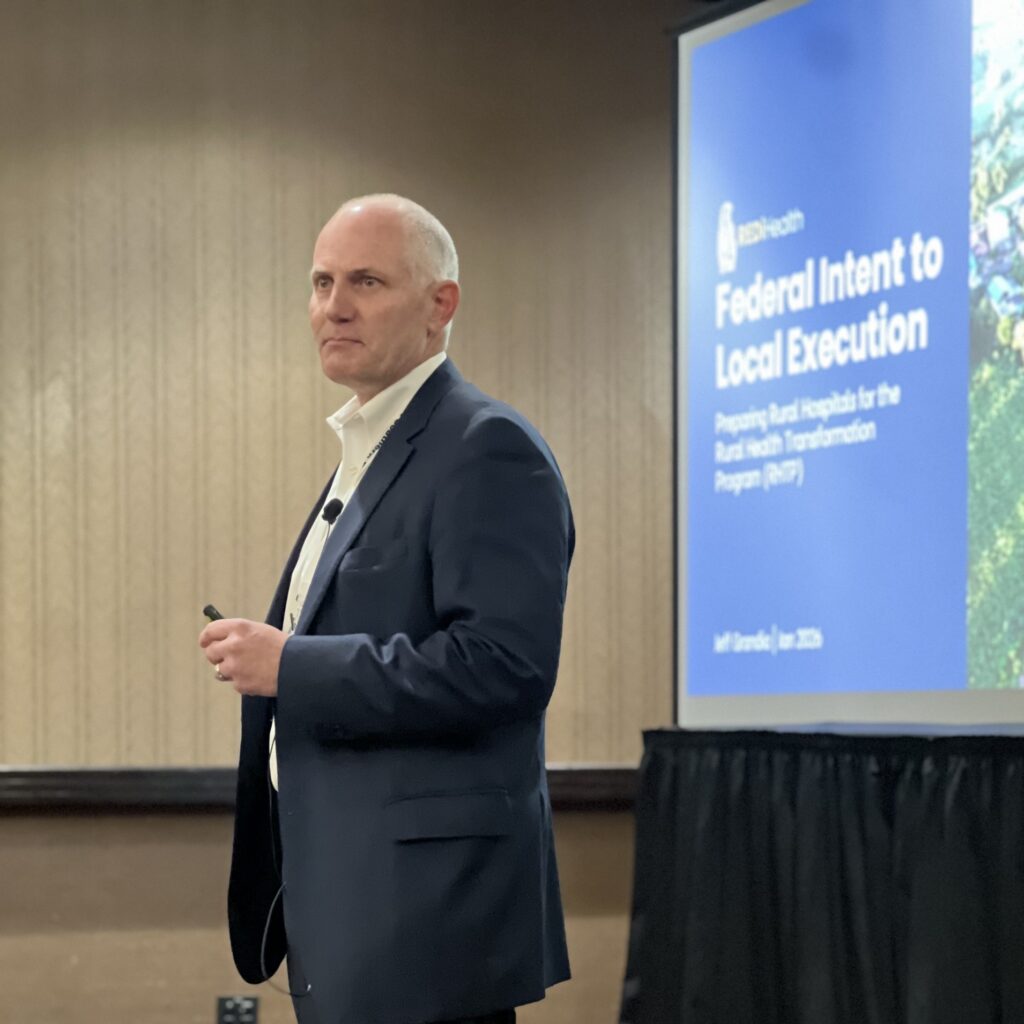
From Jeff Grandia, Co-Founder of REDi Health:
Last week, I had the opportunity to speak with HFMA members from across Louisiana, Texas, and Tennessee — with one attendee even joining from North Carolina. The room included providers, collaborators, and vendors, all deeply invested in the future of healthcare finance and delivery.
To better understand the audience, I opened with two simple questions.
First: Where is everyone from?
The room responded with regional pride and diversity.
Second: How many of you are familiar with the Rural Health Transformation Program (RHTP) and actively engaged in what your state is doing with it?
Fewer than 20 attendees raised their hands. No one indicated they were directly engaged with their state’s RHTP efforts.
That response shifted the session from a presentation into a broader discussion. Because RHTP has significant implications for nearly everyone working in rural healthcare — and engagement at this stage matters.
Federal Funding and Rural Healthcare: A Pattern of Survival
Federal investment in rural healthcare has historically been episodic and reactive. Programs have often focused on stabilization — grants to prevent closures, emergency relief during crises, or demonstrations aimed at short-term cost containment.
Initiatives such as Critical Access Hospital (CAH) designation, Disproportionate Share Hospital (DSH) payments, and emergency relief funding have helped rural providers survive difficult periods. However, survival does not equal sustainability.
Funding has frequently arrived late, carried restrictive requirements, or failed to address the structural realities rural communities face: workforce shortages, aging infrastructure, declining patient volumes, and limited access to capital.
RHTP introduces a different type of opportunity — one oriented toward structural transformation rather than temporary stabilization.
An Inflection Point for Rural Healthcare
Rural healthcare is entering a defining period. The future will not be shaped solely by inpatient volume or uniform policy solutions. It will depend on models that reflect rural realities — stronger regional collaboration, smarter use of data, and care delivery strategies that extend beyond hospital walls.
RHTP was structured to support this type of evolution. It gives states flexibility to design transformation strategies aligned with local needs rather than relying on a one-size-fits-all framework.
That flexibility creates space for thoughtful redesign across care models, workforce development, financial sustainability, and digital infrastructure. The decisions made now will influence how rural healthcare is organized and financed for years to come.
Why Engagement Matters
What stood out most in Louisiana was not simply limited awareness — it was limited participation.
RHTP will move forward regardless. The more important question is who helps shape it.
Every stakeholder in rural healthcare has a role:
Providers define what transformation looks like in daily operations.
Collaborators and advisors bring structure, analytics, and scalable strategy.
Industry partners contribute tools and expertise that states often cannot build internally.
When these voices are absent from state conversations, transformation risks becoming disconnected from operational reality.
For those working in or alongside rural healthcare, this is a critical moment to:
Understand your state’s RHTP priorities
Participate in advisory groups or work sessions
Contribute data and operational insight
Advocate for approaches that are sustainable in rural settings
RHTP represents one of the most consequential rural healthcare initiatives in recent memory. Its long-term success will depend on informed engagement and disciplined execution.
The moment in Louisiana was a reminder that transformative opportunities do not always arrive with widespread visibility. Sometimes they begin quietly — and it is up to us to lean in.